
The framework I describe here is a process for remaining intact amidst all that comes at us over the course of a day, a week, a month, a lifetime. Every morning, we wake up and set about our day. In the hours to come we will experience a continuous stream of pressures, big and small, testing our in-the-moment soundness of mind and body. For example:
Minimal pressure: You’re walking down the street and come to a crosswalk. Car after car blows right through the well-marked crosswalk without giving you a thought. You feel a spark of indignation. It’s a mild disturbance, a momentary ruffling of feathers. You’re still solid.
Moderate pressure: You’re walking down the street. It’s early morning and peaceful; you’ve got the street to yourself. Then a garbage truck joins you, emptying each garbage can with the precise cadence required to keep your pace. You feel a flash of displeasure and the slow burn of moderate resentment. The load on your framework has started to build.
Major pressure: You’re walking down the street. You’re enjoying yourself with no reason to anticipate trouble when your phone rings. It’s a friend, very angry. There are accusations: you have put them in a terrible position and caused them much distress by some insensitivity you committed the evening before. Alarm bells are going off and your heart is racing as you scramble to understand what is going on. As your mind darts wildly around, it’s hard to hold it together and maintain coherence with all that is coming at you. You feel yourself start to fragment.
From mild disturbance to major upset, the pressure of the oppositional forces of our daily experiences pushes against our structural integrity. As with a house, if the accumulated load is too much, we start to crack a little or a lot. And much like the cornerstones of a house give it strength, the integrity of our own internal cornerstones determine how well we can hold it together.
With a little ongoing TLC, a house and its surrounding property does an excellent job of providing us a good home — a place of shelter, sanctuary, and backdrop for the playing out of life. The same is true for our own personal structure of mind and body. With a process and a little ongoing TLC for ourselves, our flesh and blood property can be there for us, holding us up, even when life gets messy and threatens to bring us to our knees. That’s what is on offer here: a process for keeping it together.
Process
In this framework, our structural integrity is comprised of two elements:
- The four cornerstones of our makeup: Body, Intellect, Emotion, and Spirit
- A well-defined property line that offers protection
In a nutshell, here is the whole premise of this framework: When we recognize how our cornerstones relate to each other and the whole, they can be productively leveraged to tether us together. When our property line is well-supported, we have created a safe space to see clearly and think straight.
Element #1. The Four Cornerstones of Coherence – Body, Intellect, Emotion, Spirit
When we get thrown out of whack, it’s because on some level:
- Our Intellect is not helping to anchor our Emotions with thoughts that are steadying,
- Our Body has not been recruited to regulate our system through breathing and grounding, and
- Our Spirit — that part of us that has access to awe, to a sense of interconnection, and to a sense of one’s own meaning and purpose in the world — is completely lost in the upheaval.
We all know what it feels like to get triggered and spin out, like we are coming undone and apart at the seams or can’t think straight because we’re blinded by emotion. Until our parts are unified in their mission and working together, we’ve lost a certain level of coherence, a certain level of order and togetherness. The longer we stay in that space of incoherence or fragmentation, the less our life is as we would want it and the more unhappy/unsettled/desperate we feel. Our job: get a handle on our parts and bring them back together.
Unifying Our Cornerstones
We can think of our parts — Body, Intellect/mind, Emotion and Spirit — as being loosely associated with a different quadrant of our brain according to the way the brain functions, two in the front and two in the back.* Emotion and Body are in the older, back part of the brain where processes are automated and unconscious. Intellect and Spirit are in the new, front part of the brain where there is awareness and self-determination.

Knowing each cornerstone has a location in the brain and that when we are coming undone it’s because our cornerstones have lost their unifying connection with each other makes the process of pulling them back together simple, conceptually. In the first level of the process, re-connecting our parts involves visualizing touching base with each one, a circuit that begins with Body, crosses up and over to Intellect, drops down to Emotion and crosses back over and up to Spirit.
Starting with the body, the flow of the circuit looks like this, in figure eight formation:
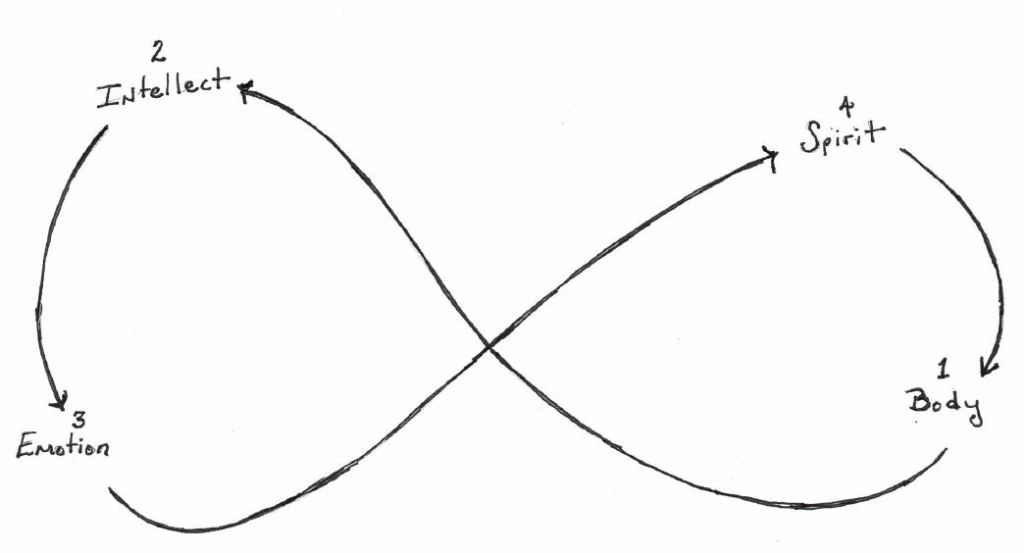
Just visualizing running that simple circuit in your mind brings these parts back into some level of relationship with each other. You have crossed hemispheres, getting the right to work with the left, the back to work with the front. You know where all your pieces are, and at least can see and feel the nature of activity going on in each quadrant as you make the rounds. This counts for a lot. You may be activated but at least everything is accounted for and contained and therefore in some level of relationship. You are no longer quite so fragmented.
*Harvard-trained neuroscientist, Indiana University School of Medicine faculty member and author Jill Bolte Taylor identifies the different functions of each quadrant of the brain in her books My Stroke of Insight and Whole Brain Living which informed how I assigned each cornerstone their quadrant.
Identifying Our Intelligence
The next level of the process involves going just a little deeper by identifying a constructive function or piece of intelligence for each cornerstone to contribute when we touch base with them. This intelligence functions in the following way for each cornerstone:
- To ground us, we first touch base with the sensation of the Body in the back, right quadrant.
- We then cross hemispheres to the Intellect in the front, left quadrant for the intelligence that will anchor the Emotion.
- From there we drop down to Emotion in the back, left quadrant for what we most need to understand in answer to an original injury that has kept us wounded and insecure, or some other deep-seated fear or anxiety that is easily triggered when a stress or distress arises.
- To complete the circuit, we cross up and over to Spirit in our front, right quadrant to get in touch with our higher levels of being and what we most need to hear from our Spirit.
As for that intelligence each part provides…this is entirely individual because for it to perform its function effectively this intelligence has to speak to a truth all parts are willing to buy into. It must touch something both believable and meaningful to each part.
This may take some digging to determine what clicks. For instance, mine for Emotion has to do with self-worth, something I didn’t know I had trouble with until much later in my life. It took a while for me to zero in on what it was Emotion most needed to be reminded of, but I finally did. You’ll know when you land on the right intelligence coming from each of your parts because you can feel something quieting as that Cornerstone shares its piece.
Once you’ve determined the intelligence for each part, say them in your mind as you make the rounds through the cornerstones. For example, here is what I say as I touch base with my Cornerstones:
- (Body): I feel my body, my breath, the ground underneath.
- (Intellect): I trust in and give myself to the process, letting all else fall away.
- (Emotion): I breathe in my divine worth.
- (Spirit): I breathe in pure love and spaciousness.
Now. You may be thinking this is all very odd and possibly even embarrassing. Yes, to both. I know what you mean. But I’ve had to get over my squeamishness about that because odd or embarrassing as it may be, it just works. It’s what those places deep within me need to hear and be reminded of or are responsive to. Most shocking to me in this process of intelligence mining was discovering how much the word “divine” speaks to me which is in stark contrast to how I grew up. Though I had a fairly conventional upbringing so far as religion was concerned, it was only during a difficult period in my later adult life that a very different connection with a more mystical, non-denominational higher power showed up and took me by surprise which explains the spiritual slant to my intelligences. However, just because my Cornerstone intelligences have a spiritual bent doesn’t have anything to do with what these intelligences are supposed to be like. Yours may be of an entirely different nature. They might have much more of a down-to-earth, pragmatic feel or some other leaning to them.
Below are some examples of other intelligences. You’ll notice that sometimes the examples use “we” and sometimes they use “I.” Using “we” can bring a team spirit to the parts and/or it can also establish a witness component – a wise piece of oneself that steps back in order to watch and advise. With me, sometimes it’s “I” and sometimes it’s “we.” I go back and forth.
Body
- I am strong
- My breath holds me steady
- I can ride the energy flowing through my body without being swept away
- We are open, fluid and flexible
Intellect
- All will be well
- We will figure it out
- I am with you
- We remember who we are
- Emotions pass. Moments pass. We adapt
- We are learning something valuable here
Emotion
- We are who we are meant to be
- We are needed
- We have what we need
- We are here for a reason
- We are loved
- We are safe
- Being vulnerable is a strength
- There is no less than or more than
Spirit
- We are a part of the bigger whole
- We are connected to the mystery
- We have purpose. Our purpose is our guide
- We are protected by love
- What flows through life flows through us
- We are all part of each other
Speed matters. Breathing matters.
As you touch base with each cornerstone, keep in mind that slowing yourself down and breathing deeply is essential to begin downregulating your nervous system. Breathing slowly and deeply, drawing out the exhale longer than the inhale, shifts our nervous system from fight/flight (sympathetic nervous system) to rest/digest (parasympathetic nervous system.)
In addition to using breath to downregulate our nervous system, remember just the very act of tracing that looping figure eight in our brain going from Body to Intellect to Emotion to Spirit begins to bring all our parts back into coherence and relationship.
The Intersection
As you practice making the rounds as a means of re-tethering the four components of our makeup in response to the spike of distressing emotions, you can think of the intersection in the very middle of that figure eight as the place where you “hold your seat.” After all, this is the juncture of all parts holding together, the juncture of our integrity and coherence. Visualizing yourself right there in the very center of order puts you in the seat of coherence.
Element #2. A Well-Defined Property Line
We need them – you can’t buy a house without the property having been surveyed and marked – but interactively there is something unfriendly feeling about boundaries, the way they keep me on one side and you on another. The implication is one of expectation that there will be some trampling on the flowers or stealing of the acreage by one party or another unless measures are taken. The big irony, though, is that with the right mindset interactive property lines are preservative of an integrity that can make for far greater feelings of open heartedness than hostility. Or maybe we should say the right heart-set can make for more rewarding, less threatening relationships with ourselves and others.
Why the line
It is hard to recover regulation when being bombarded by reactive thoughts and emotions. It’s as if these reactive thoughts and emotions are objects physically invading our space, giving us no room to breathe or think straight. We need a way to create some measure of distance between us and our thoughts/emotions and the object of those thoughts and emotions so as to interrupt the cycle of threatening thoughts driving anxious emotions so we can calm down enough to think clearly.
But how to get away from thoughts and emotions and the object of those thoughts and emotions when they are right there in our face and inside our head? The amazing thing about the human mind is that we can create that distance purely through imagination. As an expansion of the house metaphor in House, we can achieve a protective boundary by visualizing a property line around our house (house being our brain/body/being). Not only are the external objects of our constrictions (people, events, circumstances, etc.) held on the other side of our property line but we can also clear our internal space of the thoughts and emotions in reaction to the external objects of our constriction by externalizing them. Making our internal space private in this imaginative way provides the safe container we need to lessen the sense of threat, gather ourselves up, recover our composure and think clearly.
When a disruption comes up, then, we first visualize a line around our property with the external objects of our constriction on the other side of that line and then imagine moving the thoughts and emotions associated with the object of that constriction out of our internal space and over to the other side. In other words, we are externalizing our thoughts and emotions so we can get some distance from them to see more clearly. Distance disarms.
There is a danger, however, in drawing a protective boundary around ourselves: it can become a barricade, a defensive, even hostile stance to take. This only perpetuates the signal of threat to our nervous system which, in turn, ensures a hostile regard for anything that causes us to feel bad, even if what is making us feel bad is just a story we’re telling ourselves about a person or situation. For that reason, I think of our property line as a boundary line of love.
Again, I know. This is embarrassingly earnest and recklessly maudlin in its innocence. But think of it this way. While we may not love the object of our constriction in a direct and specific way (at least in that moment), love in the broadest sense of the word acknowledges the common humanity of all involved, allows the heart to soften and reduces the sense of threat. We can equate love with open-heartedness and a recognition that we all suffer, we all struggle, we all have fears which are often at the heart of our behavior. Bringing the very idea of this definition of love into the equation and warmly setting the objects of our constriction on this line of love with a smile instantly relaxes our nervous system and allows us to breathe easier.
All told, choosing to be protected by a boundary of love rather than a boundary of hostility is a much more productive place in which to situate oneself. It creates an environment where we can have a more secure and open-hearted response to the situation as opposed to an automatically defensive and hostile one, which only perpetuates a default culture of threat and opposition. A line of love doesn’t feel so maudlin after all.
Putting It All Together
Back at the beginning I laid out the two elements in this framework that comprise our structural integrity:
- The four cornerstones of our makeup: Body, Intellect, Emotion, and Spirit
- A protective, well-defined property line
In that way, all we are doing here in this framework is drawing a property line around our “house” to create a safe, clear space to see and think clearly and touching base with each cornerstone to unify them and productively bring forward the intelligence each has to offer.
Your Kind of House
There is just one last piece to the portion of the framework I’m sharing here**: declaring the kind of house we are building and living in.
What kind of Body/Intellect/Emotion/Spirit house do you want to live in? What qualities do you most need to feel safe and secure in your domicile? What kind of place would you most want to come from, informing and influencing how you put yourself out there in the world?
I have found that the kind of house I most need to build for myself and live in is one of love, grace and healing. Therefore, my declaration is this:
“I live in a house of love, grace and healing.”
That’s just me. I didn’t know that was what I needed but it is and it helps me every day.
What about you? How would you finish that sentence for yourself? What first comes to mind when you fill in the blanks below?
“I live in a house of _____________, _____________, and _____________.”
Yours could be, “I live in a house of laughter, curiosity and perseverance.” Or “…piety, justice and balance.” Or “…ambition, growth and transformation.” Or “…kindness, honor and service.” Or “…beauty, wonder and creativity.”
These examples, including my own, are values-based, need-based and often highly aspirational when some days the real house we live in might be more like selfishness, intolerance, and despair. But with House: A Framework for Holding it Together, we get the chance to build the house we most need reflecting our deepest values and let our environment, with practice, make it so.
Putting House into Practice
While the concept of House is pretty simple, practicing the elements of House takes a certain amount of time, a certain amount of mind space and, of course, effort. No house worth living in is free of charge just like achieving our dreams takes effort. Getting a degree takes effort. Making money and maintaining relationships take effort, etc. Health and wellbeing is no different. So effort is involved, I won’t lie.
A good practice is to run through House first thing in the morning before getting out of bed to establish where you are coming from and what you stand for right from the get-go. What that recitation looks like for me:
I live in a house of love, grace, healing and four cornerstones, protected by a property line of love.
When a disturbance rises, I call to mind my property line of love, warmly placing the objects of my constriction on the line of love with a smile so I can think and see clearly.
When a disturbance rises, I touch base with each cornerstone:
- I feel my body, my breath, the ground underneath me
- I trust in and give myself to the process, letting all else fall away
- I breathe in my divine worth
- I breath in pure love and spaciousness.
When a disturbance rises, I hold my seat at the intersection of the four cornerstones and breathe, feeling the love, grace and healing of my house.
Throughout the Day
For me, when a disturbance rises during the day, I get my bearings by slowing way down and breathing, visualizing the property line and externalizing the objects of my constriction with warmth and a smile. I may go through the whole recitation of House at that point, or I might just slow way down, breathe and focus on a piece of the recitation like breathing in my divine worth.
I keep the cornerstones, the property line and the intelligences at my fingertips by thinking about House in the in between spaces of my day, running through bits and pieces of it or the whole thing. Sometimes all I can do is slow way down and breathe, and everything else flies out the window. That’s okay, too. And then sometimes I’m not successful at all in the moment of calling on House and totally blow it but it’s always there in the aftermath, helping me come back home. While House is good in the moment, it’s always good for gathering up the pieces, too.
Bottom line, giving House some mind space throughout the day will help get it into your molecules so it will be there for you, if not in the moment, then afterward. In that way, it becomes part of your structural integrity.
Takeaway
If you’ve gotten this far, I know you will take something from this. Maybe just the idea that we have cornerstones in our makeup which are body, mind, emotion, and spirit. Maybe how it is that we can trace a figure eight in our head that serves to bring our left brain in connection with our right, our back brain in connection with our front brain and in making those connections we can tether ourselves together. Or that we have structural integrity like a house, and we can work with the inner engineering to reinforce our stability. Perhaps just naming the kind of house you most need to be healthy and whole will point you in a different direction. Or maybe simply that we need shelter. Sometimes we can just feel almost skinless and exposed to the elements.
Whether you adopt and practice the whole process or find that a piece has lodged itself into your consciousness simply because I said it would, I hope you find something here that sparks your imagination.
** The process laid out here is a part of a larger framework from a book I am writing of the same title. The larger framework goes deeper into techniques for seeing and thinking clearly, values, what you need to be reminded of and the truths that you aim to live by.
One final note: I don’t go into detail in the portion of the framework shared here about a process for thinking and seeing clearly after clearing space in our mind via the property line for reasons of length but one small piece of that process I’ll leave you with here is the insight that can be gained from asking yourself what you are afraid of. If we can name what we are afraid of it may bring new understanding of the situation to light and alter how we decide to respond. At the very least, simply naming what we are afraid of creates a bit of distance from that fear because saying it externalizes it. Recognition creates distance. Distance disarms.
 Be cool.